Joined: May 2018 Posts: 4,236 Threads: 914
Reputation:
46
Location: Peak District, Derbyshire
Car type: 1929 Chummy, 1930 Chummy, 1930 Ulster Replica, 1934 Ruby
Joined: Aug 2017 Posts: 2,003 Threads: 51
Reputation:
16
Location: Malvern, Victoria, Australia
24-01-2026, 12:53 AM
(This post was last modified: 24-01-2026, 12:55 AM by Tony Press.)
No mention of brakes on the Bleriot-Whippet. Perhaps it couldn't go fast enough to need them ?
Wonder what the hand starter operated from the drivers seat was- a pull cord ?
Joined: May 2018 Posts: 4,236 Threads: 914
Reputation:
46
Location: Peak District, Derbyshire
Car type: 1929 Chummy, 1930 Chummy, 1930 Ulster Replica, 1934 Ruby
(24-01-2026, 12:53 AM)Tony Press Wrote: No mention of brakes on the Bleriot-Whippet. Perhaps it couldn't go fast enough to need them ?
Wonder what the hand starter operated from the drivers seat was- a pull cord ?
Yes, Tony, the adverts invite far more questions than they answer. One suspects that they might have been hiding something....
Joined: Aug 2017 Posts: 1,860 Threads: 102
Reputation:
15
Location: Monmouthshire
Having changed out of my dressing gown and put on my anorak, might a few notes be of interest. The Bleriot Whippet did have fabric covered plywood body, on ash frame, much like numbers of other cyclecars, which it certainly qualified as at weight of under 8cwt, sometimes reported as 6cwt. The long handle may be neither brake nor starter, but the lever for operating the Gradua expanding belt drive pulley, which connected to a back axle which moved back and forwards, thus altering the ratio. This infiitely variable ratio system was also used on some Zenith motor cycles. Transmission later became chain or shaft drive involving a gearbox. Brakes are a very interesting question, how do you operate brakes on a moving back axle, other than Bowden cable perhaps. Certainly no images seen by myself show any drums visible behind wheels, and belt or chain drive does not offer transmission brake. Anybody have a Bedelia, Carden or Chater Lea in ther motor house to inspect how bakes work on a similar cyclecar? The Whippet had a breif and less than sucessful competition history. Entries at Brooklands in 1921 and 1922 both resuted in DNF. This machine had nothing to do with the French Bleriot cyclecar, and nothing to do with the Whippet motor scooter. The Whippet was still being offered for sale in 1927, actual building them had probably stopped some time before. There can be no better illustration of why the Austin Seven became so famous and changed motoring history, whilst sadly wiping out cyclecars.
Joined: May 2018 Posts: 4,236 Threads: 914
Reputation:
46
Location: Peak District, Derbyshire
Car type: 1929 Chummy, 1930 Chummy, 1930 Ulster Replica, 1934 Ruby
(24-01-2026, 09:25 AM)Steve kay Wrote: Having changed out of my dressing gown and put on my anorak, might a few notes be of interest. The Bleriot Whippet did have fabric covered plywood body, on ash frame, much like numbers of other cyclecars, which it certainly qualified as at weight of under 8cwt, sometimes reported as 6cwt. The long handle may be neither brake nor starter, but the lever for operating the Gradua expanding belt drive pulley, which connected to a back axle which moved back and forwards, thus altering the ratio. This infiitely variable ratio system was also used on some Zenith motor cycles. Transmission later became chain or shaft drive involving a gearbox. Brakes are a very interesting question, how do you operate brakes on a moving back axle, other than Bowden cable perhaps. Certainly no images seen by myself show any drums visible behind wheels, and belt or chain drive does not offer transmission brake. Anybody have a Bedelia, Carden or Chater Lea in ther motor house to inspect how bakes work on a similar cyclecar? The Whippet had a breif and less than sucessful competition history. Entries at Brooklands in 1921 and 1922 both resuted in DNF. This machine had nothing to do with the French Bleriot cyclecar, and nothing to do with the Whippet motor scooter. The Whippet was still being offered for sale in 1927, actual building them had probably stopped some time before. There can be no better illustration of why the Austin Seven became so famous and changed motoring history, whilst sadly wiping out cyclecars. Thank you, Steve, for those most interesting details. Yes, by perhaps the middle of 1923, when compared with a cyclecar, the Seven had really evolved into a 'proper job'.
Joined: Aug 2017 Posts: 2,003 Threads: 51
Reputation:
16
Location: Malvern, Victoria, Australia
The often used Bobbin Steering didn't seem to be the way to go. 
Joined: Oct 2017 Posts: 2,049 Threads: 74
Reputation:
10
There are 3 cars which don't appear to have brake drums so how do they stop?
Joined: Aug 2017 Posts: 1,136 Threads: 145
Reputation:
4
Location: Melton Mowbray.
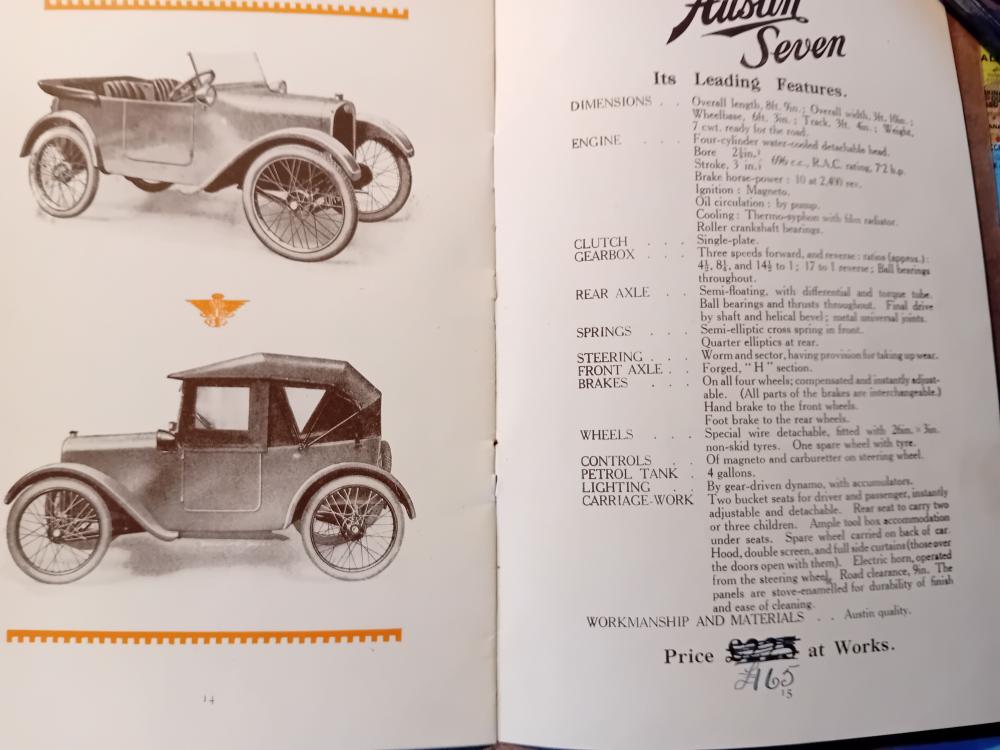
My original 1922 The Motor for the Million brochure showing the £225 Price at Works scored out and overwritten as £165 by a salesman.
Joined: Aug 2017 Posts: 3,423 Threads: 201
Reputation:
40
Location: Sherwood Forest
Car type: 1939 Big Seven 6-light
(25-01-2026, 11:20 AM)Dave Mann Wrote: There are 3 cars which don't appear to have brake drums so how do they stop?
None of the Seven's rivals shown here had front-wheel brakes; the TB has a conventional drum brake on the back axle, the Tamplin and the Bleriot had some sort of transmission brake.
Joined: May 2018 Posts: 4,236 Threads: 914
Reputation:
46
Location: Peak District, Derbyshire
Car type: 1929 Chummy, 1930 Chummy, 1930 Ulster Replica, 1934 Ruby
25-01-2026, 02:04 PM
(This post was last modified: 25-01-2026, 02:07 PM by Tony Griffiths.)
(25-01-2026, 01:19 PM)Mike Costigan Wrote: (25-01-2026, 11:20 AM)Dave Mann Wrote: There are 3 cars which don't appear to have brake drums so how do they stop?
None of the Seven's rivals shown here had front-wheel brakes; the TB has a conventional drum brake on the back axle, the Tamplin and the Bleriot had some sort of transmission brake.
No wonder the Seven's promise of 4-wheel brakes was appealing....even if they proved, of course, not to be as powerful as expected (though probably 'adequate' for the time).
"Front-wheel brakes, madam? Most dangerous and skid-inducing. Only expect drivers can handle their fierce power. Our safety-first single brake with double-cable operation on the back wheels is far superior."
|