
Welcome to the Austin Seven Friends web site and forum
To get a quick overview of all the messages click on
" Switch to Threaded style "
A good friend completed his special build this Christmas and is now getting ready for his first sprint. He keeps asking me "do I need this" and "what about that" but its 20 years since I did it all...
I know "its all in the regs" but I also remember that at each event I'd get pulled up on something different and it took a while before the car would go through on the nod.
What should be "on the list" to have the car ready?
David
Location: Lewisham, London.


Hi Dave I'll be watching this thread with interest as I too am going to be doing my first sprint in the Bert Hadley championship at Curbrough in August.
Regards Ian.
Location: Worksop Notts
Apart from obvious MOTable type stuff:
Return spring on throttle spindle
Timing strut
Yellow tape on positive battery lead
Battery cut out clearly labelled
Catch tank on crankcase breather and radiator overflow
Seat fastened down if tip up type
Expect a more thorough look if the scrute hasn't seen your car before, but as a minimum he's likely to feel fit steering play, kingpins and spokes. It helps if your car is clean, no leaky oil anywhere And it looks cared for.
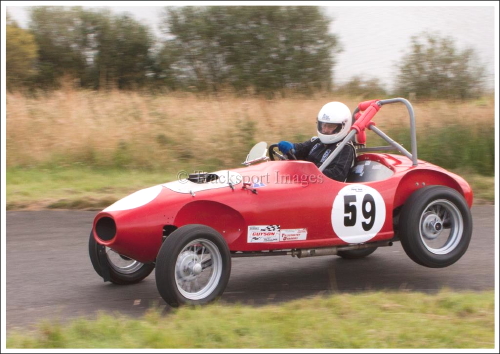
Is your friend's special going to complete in a fully road legal state (including tyres, insurance and current tax disc)?
If it is running in a fully road legal condition then not a lot needs done to the car:
Yellow tape on the battery earth lead.
Ignition switch marked with direction of off position.
Replace any brass wheel-nuts with steel locking nuts and special tapered washers.
Oil catch tank of 1 Litre capacity if engine breather vents to atmosphere.
Timing strut.
Edit - forgot about the external throttle return spring!
If the car was originally registered/built between 1 Jan 1931 and 31 Dec 1946 - it will be classified as Period defined (Period D).
That means the car does not need to run with seat belts, roll over protection, mud wings etc.
If the car is not running in a fully road legal condition then the car will require an MSA log book - obtainable from MSA Scrutineers for a modest fee and a photo of the car.
As for the driver - he will require a Speed licence (grade dependent on event level).
An FIA approved race suit
Approved flame retardant gloves
Approved helmet (specifications are listed in the current MSA 'Blue Book')
But note that BS AF/R helmets are being withdrawn.
In addition he will need to be a member of one of the clubs organising or invited to that particular Sprint Event.
As Alan mentioned, the scrutineer will also check the general condition of the basic components therefore it is advisable to do a thorough spanner check before the event.
Given the age of the vehicles a little lee way should be given with regards to free play in the steering......
My special has a fair bit of play in the central position (compared to a modern car).
This is usually not a problem - however a scrutineer at the last event wanted me to tighten it up a bit - I foolishly obliged and the resultant stiff steering on full lock nearly had me off the track.
needless to say I returned the adjustment to the original setting and told the scutineer that I had!
It has tax and insurance, very much a road car and reassuringly sturdy, certainly in contrast to mine.
I can remember the seat check!!! Mine is just a cushion on the floor. I soon learned to remove it as arguments about it being no hazard and perhaps a help in an accident cut no ice. I guess its one of the things they routinely "give a shake" checking normal cars. I'm padded enough to do without.
We weren't sure about the wheel nuts... Mine has thick but plain washers and nylocks. He'd heard that the original brass were now preferred. Does anyone know a source for the special shaped washers?
Radiator overflow is new to me as well. Mine just blows out the spout and I think his the same.
Another moot point is the fuel filler. He has a rear mounted tank with the standard cap. Is that enough or will they want that lockwired? I've said a drill and wire are worth having to hand for "last minute mods" along with an extra large roll of duck tape.
David
Location: Lewisham, London.
The radiator overflow used to be specified as requiring a catch tank but the latest MSA regulations only stipulate a 1Litre catch tank for OIL.
Ideally you don't want to drop any fluids - especially in front of your own wheels.
My friend spun off on his car's own coolant when a header tank split on his Cox GTM.
Non-ferrous wheel nuts are not permitted.
Large thick washers are OK but the ones with a taper on one side are better.
Ordinary wheel nuts, brass or steel are frowned upon if the scrutiniser knows austin sevens. You will need flat washers and self licking nuts. Nyloc are ok but I prefer the steel type. They last longer. The shaped washers are available from Al Frayling Cork. I\'m not sure of their advantage but lots like them.
Just out of curiosity ..
Why the colour yellow for the positive battery cable?
Location: On the very Edge of Europe....West of Jelbert, Brian, Alastair, Bob and everybody else..

Why the colour yellow for the positive battery cable?
Perhaps it's phase 2 of the regs.

Ian Mc.
Location: Shropshire
It's not. It's the earth that has to be marked yellow. Sorry about that. Don't ask why just do it. It's the MSA not a reasonable organisation.
Thank you all for taking the time to answer here...
Anyone got contact details for Al Frayling Cork? If not willing to post here feel free to email me directly or give me clues how to track him down.
Location: Lewisham, London.
I can see the earth being yellow (perhaps a very pale green..
 )
To me, dealing with mains electrickery wiring etc., that is more logical colour based on present day colours. 'Earth' tape is Yellow / Green striped.
On my RP, bog standard road use, + is Red, - is Green.
However, the MSA are the reference point, so that's what's required.
Location: On the very Edge of Europe....West of Jelbert, Brian, Alastair, Bob and everybody else..
Do you need a Fire extinguisher for sprints these days? It used to be required.
Spill kit for in the paddock? Not sure if its required for sprints.
I have often wondered why the battery earth has to be yellow (which it has for at least 35 years!), I recon its because it was the most unlikely colour for battery cable to be. However these days with welding flex being readily available that's not really the case!
Stuart
Location: Devon
If a fire extinguisher is required, make sure that the bracket will withstand the scrutineer giving it a firm tug! My cars rarely failed scrutineering, but if anything was going to let them down it was often the rubbishy over centre clips on fire extinguishers! A small it of gaffer tape on the clip will usually sort the problem.
Location: Devon
I got caught out at a rally recently (first time navigating, another story...) needing first aid and spill kits. With most marshalls being rally folk having a day off we were able to borrow kits. The wonders of the web the driver was able to show a photograph on his IPhone of the MOT and V5 they also needed to see.
David
Location: Lewisham, London.
You don't need a fire extinguisher for sprints unless you compete with the vscc. If you want one, it has to be AFF foam and at least 1.75litres. You'll find 2 litre ones from the internet less than half the price of Motorsport ones, and just as acceptable.
I have often wondered why the battery earth has to be yellow (which it has for at least 35 years!), I recon its because it was the most unlikely colour for battery cable to be. However these days with welding flex being readily available that's not really the case!
Stuart
It is so that the marshals can put the bolt cutters on it easily to cut all power if needed
Charles
I have often wondered why the battery earth has to be yellow (which it has for at least 35 years!), I recon its because it was the most unlikely colour for battery cable to be. However these days with welding flex being readily available that\'s not really the case!
Stuart
It is so that the marshals can put the bolt cutters on it easily to cut all power if needed
Charles
Yes of course, but why yellow?
Quote "Ordinary wheel nuts, brass or steel are frowned upon if the scrutiniser knows austin sevens. You will need flat washers and self licking nuts."
We had a dog which had those!!!!!!!
All I have to say to you is billocks
This is another of those threads that really shows the worth of A7Friends Forum, I know I'm just a road plodder, but this has been informative, I shall have to change my fire extingisher to start with - Yes I have one in the RP.
Location: On the very Edge of Europe....West of Jelbert, Brian, Alastair, Bob and everybody else..
Why change your extingisher, Sandy? The 1.75l AFF stipulation is only a MSA regulation so if you don't compete in relevant events it doesn't apply. There are arguements that dry powder is more effective at fighting fires.
Ian Mc.
Location: Shropshire
Perhaps the colour Yellow was chosen because it can be seen by all colour "blind" people as Yellow, no matter how bad they are. Red is a most difficult colour, particularly in poor light.
Spex
Location: OZ
Spex
Aha! Yes that makes sense.
Location: Devon
Back in the late 80\'s when I was competing in both national and international stage rallying we had to comply with both RACMSA and FIA regulations. One specified 2.5kg of Halon plumbed in to discharge inside the car, and the other 5kg of Halon. Result, 7.5kg of Halon plumbed in to discharge inside the car, I think we were in more danger of suffocation that being burnt in the event of being trapped inside the car after an accident. There was a further 2.5kg plumbed in to discharge in the engine compartment. This daft situation was resolved after a couple of years and shortly after Halon was banned anyway.
I agree Ian, dry powder is more versatile than AFF. I believe AFF is the Motor Sport preferred system because of the danger of inhalation of the dust from a dry powder extinguisher in a closed car.
Location: Devon
Thank you all for taking the time to answer here...
Anyone got contact details for Al Frayling Cork? If not willing to post here feel free to email me directly or give me clues how to track him down.
David
I have e-mailed you Al Frayling-Cork's contact details. He has locking wheel nuts and washers in stock.

I have some questions regarding the specifics of sprint prep:
With regards to the oil catch can:
How do folks go about joining the row of holes along the tappet cover to the can?
The quantity of oil that extrudes itself from my engine far exceeds anything that breaths out of those holes, I assume I'll need to address this. Is it a case of mopping up before the scrutineer looks, or is a more permanent solution expected?
Seats:
My seats are hinged off the flat floor (in a way that I imagine a Nippy is), how do I go about fixing them down?
Battery:
Mine lives behind the seat, with the seats fixed I won't be able to get to it, but how secured/sealed does it need to be. Good luck trying to cut the earth strap
any photos or links gratefully received.
Andy
Location: Oxfordshire
Andrew, If you fancy coming over to Bicester area (OX26 5EL) with your car we can run though it with you , I am involved with all types of race cars (Vintage/Classic/Modern) and also build my own hillclimb singleseater.
Ooops also do lots of A7 work too (builds and fabrication of all manner of parts)
Seats - you'll have to find a way...
Breather - perhaps a cast cover to the tappet chest?
Oil leaks - NOT AT ALL POPULAR. If its seen dripping you won't be let out for the obvious reason of the oil on the track being a hazard.
Having an experienced eye over it would be a sensible first move.
David
Location: Lewisham
Seal the holes up in the tappet chest cover and make a separate breather either from a union fixed to a hole drilled in the tappet cover or from a union fitted into the oil filler neck. Connect via a pipe to your catch tank. My Ulster has the latter as in the photo below.
As to oil leaks, they are very much not welcome and their is no need for them to occur these days.
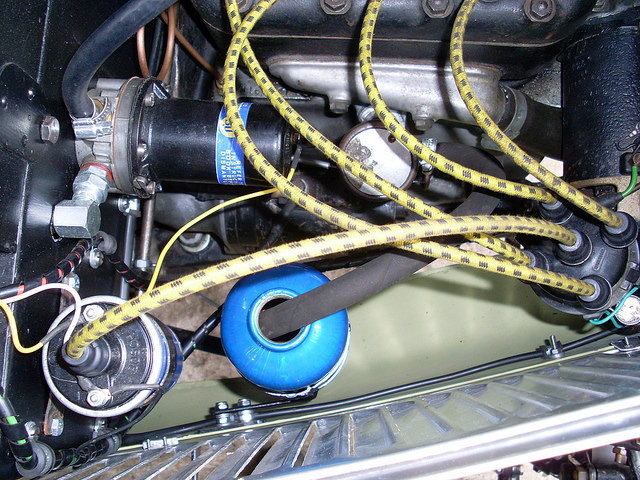
Steve
Location: North Yorkshire
Thanks for the relies.
Jo - I may well be in touch in a month or so
Steve - thanks for the pics, I hadn't considered using the fill tube, it looks neat.
With regards to oil drips, for a number of years I've been one of the first slick shod cars up the hill after the 'oil spreaders', so I'm not keen on them. That said, I'm regularly told that 'they all leak, that how so many chassis have survived'. I'm glad to hear that drip free is possible, it gives me something to aim for.
On the seat question, I was at the Autosport show on Friday, it was suggested that I use a ratchet strap  errr, maybe not....
Andy
Location: Oxfordshire

Steve, strongly suggest a rubber grommet in the hole where the fuel pump union goes through the bulkhead, and I think that the catch tank needs to be 2 litres.
Location: Soggy Hereford
I think it's 1L for speed events and 2L for circuit up to 2L engine.
Location: Oxfordshire
Hi Andrew
When I first started competing in my Dads Austin 7 the seats were only fixed to the floor by two hinges at the front. Never had any trouble with the scrutineer's in seven years.
If the battery is in the drivers compartment it needs to be contained in a securely located leak-proof container. I got caught out by this as the battery was located in the tail behind the drivers seat with no cover or bulkhead. We subsequently fitted one. Apparently it is to stop battery acid leaking everywhere if a car rolls over.
You are correct, for speed events only a 1 litre oil catch tank is required. it needs to be made of transparent material or have a method of checking if the is any liquid inside. Mine is connected via a pipe from a single hole in the valve chest cover but I know a number of competitors who use the oil filler method described above.
Feel free to drop me an e-mail if you have any other questions.
Tom